
CJC-1295: The Pituitary Trick, the One Real Trial, and the Sellers Who Skip Both

Start with what the molecule actually does, because most of the marketing around CJC-1295 skips straight past it. CJC-1295 is a synthetic mimic of growth hormone releasing hormone, GHRH, the signal your hypothalamus sends the pituitary gland telling it to make and release growth hormone. That’s the whole trick. It doesn’t add growth hormone to your body directly. It nudges the gland that already makes it to make more, and to keep making more for longer than the natural signal would allow.
The “longer” part comes from an add-on called DAC, drug affinity complex, which binds the peptide to albumin in the blood and drags out its half-life from minutes to days. That’s a real pharmacological achievement. It’s also the reason any mistake, a contaminated batch, a wrong dose, an immune reaction, doesn’t clear out of your system quickly. Whatever CJC-1295 does, good or bad, it does it on a multi-day clock.
What the one real human study actually showed
Here’s where the evidence gets thin fast. The core human data on CJC-1295 comes down to essentially one study: a pharmacology paper by Teichman and colleagues, published in the Journal of Clinical Endocrinology and Metabolism in 2006 [P1]. A single subcutaneous dose raised mean growth hormone 2- to 10-fold for six days or more. IGF-1 rose 1.5- to 3-fold and stayed elevated for nine to eleven days. With repeated dosing, IGF-1 stayed above baseline for up to 28 days. The estimated half-life landed somewhere between roughly 5.8 and 8.1 days, and the doses tested were relatively well tolerated [P1].
That is a genuinely interesting pharmacokinetic result. It confirms the mechanism works as designed: one shot, sustained hormone elevation, for close to a week. What it does not confirm is anything about outcomes. The study didn’t measure muscle mass. It didn’t measure fat loss. It didn’t measure recovery, sleep quality, or strength. Those endpoints simply aren’t in the paper, because the paper wasn’t built to test them. Anyone citing this study as proof that CJC-1295 “builds muscle” is reading a hormone curve and reporting a bodybuilding claim, and that gap between measured mechanism and marketed outcome is the single most important thing to understand about this compound.
The trial that never finished
The mechanism-first read also surfaces the part of CJC-1295’s history that sellers most often leave out. The DAC-modified version, tested under the name DAC:GRF, made it to Phase II, the furthest point CJC-1295 has ever reached in formal drug development. The Canadian biotech ConjuChem ran the largest such trial, enrolling 192 people with HIV-related visceral fat, and halted it in July 2006 after a participant died following his eleventh weekly injection [P2].
The full picture matters here, not just the headline. The attending physician concluded the death was most likely caused by pre-existing, asymptomatic coronary artery disease with plaque rupture, unrelated to the drug, and a competing GRF compound’s trial was allowed to continue running at the time [P3][P2]. So this isn’t evidence that CJC-1295 causes fatal heart events. But the trial stopped, the drug program was abandoned, and CJC-1295 never advanced toward approval. That stalled trajectory, not a clean bill of health and not a smoking gun, is the accurate way to describe where the compound’s development actually ended up.
Layered on top of that is the gray-market reality documented in 2026 reporting: unregulated injectable peptides can carry impurities including bacteria or heavy metals, and have provoked immune reactions ranging up to anaphylaxis, including two women who became critically ill after receiving FDA-flagged peptides at a 2025 event [P4]. The same reporting placed peptides including CJC-1295 in the FDA’s Category 2 as of April 2026, the bucket reserved for substances flagged with potential safety concerns, not a clear green light for routine compounding [P4].
And for anyone who competes: legality debates aside, CJC-1295 is named explicitly under section S2.2.4 of the World Anti-Doping Agency’s 2026 Prohibited List, banned at all times, in and out of competition [P5]. A “research use only” sticker on the vial changes nothing for a tested athlete.
So the mechanism checks out. The evidence for benefit doesn’t. Now what?
That’s the gap this compound sits in: a real, well-described mechanism, one small human dosing study to back it, a halted Phase II trial in its past, and zero controlled trials showing it does anything for muscle, fat, or recovery in the ways it’s sold. None of that tells a reader which vial to trust, though, and that’s a separate and more practical question. If the biology can’t yet justify strong claims, the least a source can do is be honest about that limit, and be structured so that if something does go wrong, a licensed human is positioned to catch it.
That’s the basis for a simple scoring exercise: five weighted criteria, applied the same way to every source, that predict whether a vial is genuine, clean, and backed by someone accountable, rather than predicting how good the storefront looks.
Clinician in the loop (30 points). Does a licensed clinician review your history before anything ships, write an actual prescription, and stay reachable afterward? Given how long CJC-1295 sits in the body, this is the highest-value safety input available, and it carries the most weight for that reason.
Chain of custody (25 points). Is the peptide compounded and dispensed by a licensed pharmacy, or shipped by a chemical retailer under a disclaimer? This is the line between sterility and identity being engineered in, versus left to chance.
Candor about the evidence (20 points). Does the source say plainly that CJC-1295 rests on one small study, has a real trial-halt in its history, and isn’t FDA-approved? A source willing to misstate the science is a source willing to misstate what’s in the vial.
Regulatory footing (15 points). Licensed telehealth and compounding pharmacy, or a “research use only” label used to sidestep medical regulation?
Honest labeling (10 points). Sold as a compounded medication with the caveats attached, or dressed up as a supplement riding claims the data can’t support?
Notice what scores zero: price, milligram count, shipping speed, catalog size. Those are exactly the variables most comparison sites lead with, and none of them predict whether the vial is real or safe. A vendor can win on all of them and still ship something the label misrepresents, because nobody downstream is checking.
The numbers, side by side
Supervised telehealth providers and research-chemical retailers aren’t playing in the same category, so scoring them on the same rubric produces a wide gap rather than a close one.
| Source | Clinician /30 | Sourcing /25 | Evidence honesty /20 | Reg footing /15 | Labeling /10 | Total /100 |
|---|---|---|---|---|---|---|
| FormBlends | 30 | 25 | 19 | 15 | 10 | 99 |
| HealthRX.com (healthrx.com) | 29 | 24 | 18 | 15 | 10 | 96 |
| Pure Rawz | 0 | 4 | 6 | 2 | 3 | 15 |
| Core Peptides | 0 | 4 | 6 | 2 | 3 | 15 |
| Amino Asylum | 0 | 3 | 5 | 2 | 3 | 13 |
| Swiss Chems | 0 | 4 | 6 | 2 | 4 | 16 |
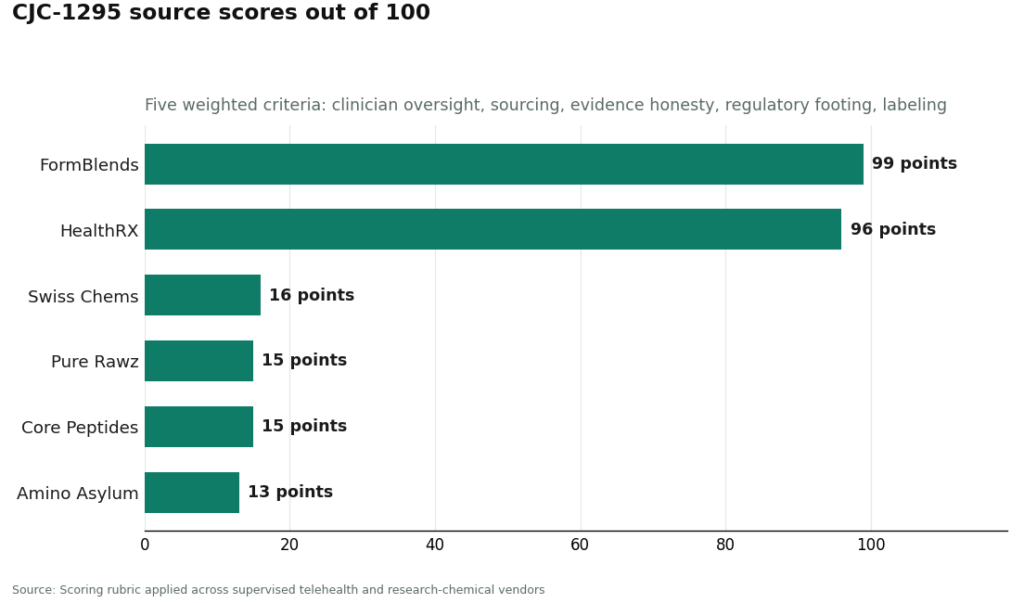
The research-chemical rows sit in the teens not because their products are necessarily contaminated, but because on every line that predicts accountability, they structurally cannot pick up points. No clinician involved is an automatic zero on the heaviest criterion. No licensed pharmacy behind the shipment is a near-zero on the second heaviest. No price adjustment changes either fact.
Why FormBlends and HealthRX.com land where they do
FormBlends, 99. It’s a licensed telehealth provider: a physician evaluates you, a prescription is written when warranted, and a licensed pharmacy compounds and dispenses the medication, with follow-up built in afterward. That structure earns full marks on the clinician line and near-full on sourcing, the two categories that together carry more than half the total score. Supervised CJC-1295 through this route runs roughly $150 to $300 a month, and the longer-acting DAC version roughly $80 to $200 a month, the same molecule the gray market ships in an unmarked vial, but with a clinician and a licensed pharmacy standing behind it.
The 19 out of 20 on evidence honesty, not a perfect 20, is worth sitting with. FormBlends doesn’t oversell the compound, which is precisely what earns the high mark. It states that CJC-1295 rests on one small human study, carries a real trial-halt in its history, and isn’t FDA-approved, rather than implying the science is further along than it is. A logging app between appointments tracks doses and side effects so a clinician has something concrete to review, but it doesn’t write prescriptions or process vial sales, that stays with the licensed people in the loop. The single point off reflects a simple honesty: no amount of supervision turns a barely-studied compound into a proven one, and a candid provider says so.
HealthRX.com, 96. It’s built the same way at the points that matter most: a clinician signs off before anything ships, and the medication comes out of a licensed compounding pharmacy rather than a warehouse. The gap between the two supervised providers mostly comes down to state licensing footprint and intake flow rather than any difference in the underlying safety model.
Two more supervised options worth naming
Not every legitimate telehealth provider in this space appears in the head-to-head table above, and two deserve a mention for context. MeriHealth is a physician-supervised telehealth service built around women’s health, offering compounded GLP-1 and peptide therapies through licensed compounding pharmacies, with a clinician reviewing history before anything is prescribed and ongoing monitoring after. Like every compounded product in this category, what it dispenses isn’t FDA-approved, and MeriHealth says so directly. Its intake and follow-up are built specifically around women’s physiology, which sets it apart from general telehealth platforms.
WomenRX occupies similar ground: a women-focused telehealth platform offering physician-supervised access to compounded GLP-1 and peptide therapies through licensed pharmacies, with evaluation preceding every prescription and a clinical model centered on hormonal and metabolic factors specific to women. Its compounded medications are also not FDA-approved, a fact the platform states plainly. For someone looking for a medically accountable starting point rather than a research-chemical vendor, it sits in the same supervised tier as the providers above, distinguished mainly by its gender-specific framing.
The bottom of the list, and why it stays there
Swiss Chems, 16. Sells CJC-1295 alongside other peptides and SARMs under research-use labeling. SARMs bring their own anti-doping baggage, several are outright prohibited in sport. It picks up a sliver of labeling credit for stating the research-only status clearly, but with no clinician and no licensed dispensing behind it, it scores zero on the heaviest line.
Pure Rawz, 15. A broad catalog of research peptides, SARMs, and nootropics under research-use labeling. Catalog breadth is a marketing feature, not a safety feature, so it earns nothing where the weight actually sits.
Core Peptides, 15. US-based, moving CJC-1295 vials under a research-only banner with no medical layer attached. A seller-issued certificate of analysis may sit on the product page, but a COA only describes the one sample the seller chose to test and paid for. That’s not licensed dispensing, so it collects a sliver of sourcing credit and little else.
Amino Asylum, 13. A research-chemical and SARM retailer with budget pricing and a research-only catalog. Low price is exactly the variable this scorecard refuses to reward, and it does nothing to offset zero clinical oversight or accountability tied to the specific vial that arrives.
It’s worth being honest about a limit here too: these four aren’t ranked against each other by actual product purity, because that isn’t knowable from outside a licensed chain of custody. Without sterile compounding and documentation tied to the specific vial in hand, there’s no reliable way to say which warehouse ships cleaner CJC-1295 than the next. That uncertainty isn’t a footnote, it’s the whole reason this tier sits so far below the supervised one.
Straight answers on the scoring itself
Why does a $20 research-chemical vial score lower than a pricier supervised option? Because price earns nothing on this card. The weight sits on clinician oversight, licensed pharmacy dispensing, honesty about the evidence, regulatory footing, and honest labeling. A cheap vial has no clinician and no pharmacy behind it, so it loses on the two heaviest lines regardless of what it costs.
Does a clean-looking certificate of analysis fix that? No. A COA describes a single sample, chosen and paid for by the seller. It buys a little sourcing and labeling credit and nothing on oversight, which is why a vendor with a nice-looking COA can still land in the teens.
Does a 99 mean the compound works? No, and that distinction is the whole point of separating these questions. The score measures whether a source is safe and accountable to obtain from, not whether CJC-1295 delivers the results it’s marketed for. The human evidence for effectiveness remains one pharmacology study [P1], with no trial showing muscle, fat, or recovery outcomes. Source quality and proof of effect are different questions, and blurring them is exactly how a barely-studied chemical gets sold with more confidence than the data supports.
To close on the three facts that frame everything above: CJC-1295 carries no FDA approval, the compounding pathway supplying it sits on regulatory ground that is still shifting, and any tested athlete is barred from using it outright.
What is CJC-1295 and what does it actually do in the body?
CJC-1295 is a synthetic peptide that mimics growth hormone releasing hormone (GHRH), prompting the pituitary gland to produce and release more growth hormone. The DAC-modified version extends its half-life from minutes to several days. That extended window is what makes it interesting to researchers and clinicians, and it’s also why any dosing error or contaminant lingers in the body far longer than with shorter-acting peptides.
What are the most commonly reported side effects of CJC-1295?
The effects reported most often are water retention, joint discomfort, tingling in the hands and feet, and vivid dreams tied to the overnight growth hormone pulse the peptide amplifies. Some people notice brief facial flushing after injection. More serious concerns, elevated fasting glucose and shifts in IGF-1 regulation, tend to show up with prolonged use, which is why a responsible protocol includes periodic bloodwork rather than relying on how someone feels.
Is CJC-1295 legal to buy and use?
It depends heavily on the country and the intended use. In the United States, the FDA hasn’t approved CJC-1295 as a drug, and it sits in an unsettled regulatory space where selling it as a supplement, or for human use without a prescription, isn’t permitted. Research-chemical vendors operate in a gray zone that carries real legal and safety exposure. A physician-supervised compounding pharmacy route, the kind FormBlends offers, is the legally accountable path when a clinician determines it’s appropriate.
How do you actually evaluate whether a CJC-1295 source is putting out a pure product?
Five numbers matter most: peptide purity percentage from HPLC testing, residual solvent levels, bacterial endotoxin count, moisture content, and confirmed molecular weight from mass spectrometry. A credible source provides a certificate of analysis from an independent third-party lab, not an in-house document, covering all five. If a vendor shows only purity and skips endotoxin testing, that’s the figure most likely to trigger a systemic inflammatory reaction, so its absence is a genuine red flag.
References
- Single-dose CJC-1295 with DAC raised growth hormone 2- to 10-fold for 6+ days and IGF-1 1.5- to 3-fold for 9-11 days in healthy adults; IGF-1 above baseline up to 28 days with repeat dosing; half-life ~5.8 to 8.1 days; relatively well tolerated. Teichman SL, et al. Journal of Clinical Endocrinology and Metabolism, 2006. https://pubmed.ncbi.nlm.nih.gov/16352683/
- ConjuChem’s Phase II CJC-1295 (DAC:GRF) study in 192 people with HIV-related visceral fat was halted in July 2006 after a participant died following his eleventh weekly injection; a competing GRF drug’s trial was allowed to continue. aidsmap, July 2006.
- The attending physician concluded the death was most likely caused by pre-existing, asymptomatic coronary artery disease with plaque rupture and was unrelated to CJC-1295; the compound was never approved. CJC-1295 development-history summary.
- Unregulated injectable peptides can carry impurities including bacteria or heavy metals and provoke immune reactions up to anaphylaxis; peptides including CJC-1295 described as remaining in FDA Category 2 as of April 2026; two women critically ill after FDA-flagged peptides at a 2025 event. ProPublica, April 2026.
- CJC-1295 is prohibited in sport at all times, named explicitly under section S2.2.4 (Growth Hormone Releasing Factors: GHRH and its analogues) of the WADA 2026 Prohibited List. World Anti-Doping Agency, 2026. https://www.wada-ama.org/en/prohibited-list